More Than a Menu: The Taco Truck as Neighborhood Lifeline
Photo: Delicata, CC BY-SA 4.0, via Wikimedia Commons
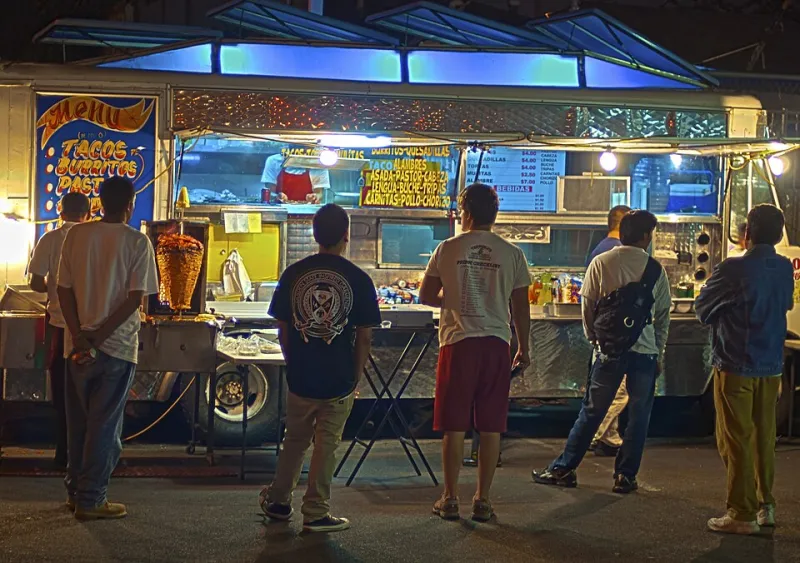
Let's be honest. When most people pull up to a taco truck, they are thinking about one thing: how fast they can get food into their face without embarrassing themselves in front of strangers. That is a completely valid life goal. But somewhere between the first order and the third napkin, something else happens at the better trucks. You notice the guy behind you already knows the owner's name. The woman at the window is getting directions in Spanish. A handwritten flyer taped to the side panel is advertising a free legal clinic on Thursday. And suddenly you realize you are not just at a taco truck. You are at the unofficial community center of this entire block.
This is not an accident. It is a design feature.
The Window as a Front Door
Immigrant communities in the US have always built their social infrastructure in plain sight — barbershops, panaderías, church parking lots. The taco truck fits neatly into that lineage. It shows up where other institutions won't, operates on hours that work for people who start shifts before sunrise, and charges prices that don't require a credit check to afford.
What makes the taco truck uniquely powerful is its mobility combined with its consistency. A truck that parks in the same spot every Tuesday through Sunday becomes a fixed point in a neighborhood's mental map. People know where it is. They know when it opens. They trust it. That trust — built one order of al pastor at a time — becomes the foundation for everything else.
In Los Angeles, there are trucks that have been serving the same corner for fifteen, twenty years. The owner knows three generations of the same family. She knows who just got out of the hospital, who lost a job, who needs a ride to a citizenship appointment. The food is the entry point. The relationship is the whole point.
What's Actually Happening at the Window
In Houston's East End, a taco truck operator named Señora Rosario — who asked that her last name not be used — keeps a small binder behind her steam trays. Inside: contact information for immigration attorneys, a list of local shelters, a schedule for a monthly English-language class hosted in the parking lot of a nearby church. She prints fresh copies every few weeks. She does not advertise this. She does not need to.
"People come to eat," she says, flipping a row of tortillas with the calm efficiency of someone who has done this approximately ten thousand times. "But they also come because they know someone here will help them figure something out."
This is more common than most people outside these communities realize. Across the country — in Chicago's Little Village, in Fresno's Chinatown-adjacent barrios, in the meatpacking corridors of western Kansas — taco trucks function as informal hubs for resource-sharing that would cost a mid-sized nonprofit serious grant money to replicate.
Bail fund flyers. Know-your-rights cards. Voter registration information in Spanish. Announcements for mutual aid drives. These things live on the sides of trucks and in the conversations at the window. No app required.
The Economics of Community
Here is the part that should genuinely humble anyone who thinks philanthropy only happens with a tax form attached. A significant number of taco truck operators actively redirect a portion of their revenue — informally, without fanfare — into the communities they serve. A free meal for someone who can't pay. A $20 bill slipped to a regular who just got evicted. Sponsorship of a kid's soccer league. Catering a quinceañera at cost because the family has been coming to the truck for a decade.
None of this shows up in a press release. Most of it doesn't show up anywhere. It is just the way certain operators understand their role in the neighborhood.
In some cases, the support is more organized. Trucks in heavily undocumented communities have been known to contribute to local bail funds, particularly during periods of heightened ICE activity. Others have partnered with community organizations to host pop-up vaccination clinics, school supply drives, and job fairs — all in parking lots, all fueled by the gravitational pull of good tacos.
The logic is simple: if people are already coming to you, you can connect them to things they need. The taco truck becomes the infrastructure because it is already trusted. Everything else flows from there.
Why Cities Keep Getting This Wrong
Here is where things get a little uncomfortable. The same municipalities that have historically tried to regulate, restrict, and occasionally outright ban taco trucks have been spending millions of dollars trying to build "community engagement" in those same neighborhoods. Task forces. Advisory panels. Listening sessions in conference rooms that smell like carpet cleaner and broken promises.
Meanwhile, Señora Rosario's binder is doing more actual community outreach than most city-funded initiatives manage in a quarter.
The taco truck works as a community hub precisely because it is not trying to be one. It does not require a grant application or a neighborhood liaison or a PowerPoint presentation about stakeholder engagement. It requires good food, fair prices, and an owner who gives a damn about the people on the other side of the window. That combination is rarer than it should be, but when you find it, the effect is real and lasting.
Cities that are serious about supporting immigrant communities should be asking how they can make it easier for these operations to exist — fewer permit hurdles, better access to commissary kitchens, protection from the kind of predatory zoning enforcement that tends to target trucks in low-income neighborhoods. Not because taco trucks are charities. Because they are infrastructure.
The Chingon Truth
There is a reason the taco truck has survived every wave of food trend, every attempt at gentrification, every health department crackdown, and every think piece declaring it either dead or suddenly cool again. It survives because it serves a genuine need, and not just a culinary one.
The food is the reason people show up. The community is the reason they keep coming back. And the owners who understand that — who treat their window as something more than a transaction point — are doing something that most institutions, public or private, have completely failed to figure out.
So next time you're standing at that window, waiting on your order, take a second to look around. Read the flyers. Notice who else is there. Notice how the owner talks to the regulars. You might be standing at the most functional piece of social infrastructure in that entire zip code.
Also, the tacos are probably excellent. That part matters too.