Your Usual? The Strange, Loyal, Beautiful Relationship Between a Regular and Their Taco Truck

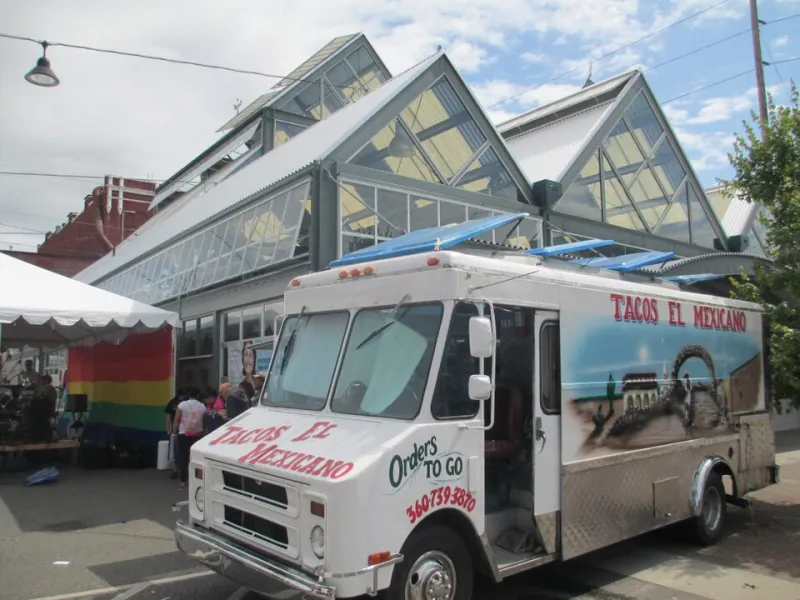
Photo: Ron Cogswell from Arlington, Virginia, USA, CC BY 2.0, via Wikimedia Commons
There are people in this country who have eaten at the same taco truck every single week for years. They know the owner's kids' names. The owner knows their order before they open their mouth. Nobody planned for this to happen — it just did, one Tuesday lunch at a time.
This is a story about tacos, sure. But it's really a story about what happens when a parking lot becomes a place that matters.
The Ritual Nobody Admits Is a Ritual
Ask someone why they go back to the same taco truck week after week and they'll probably tell you it's because the food is good. And they're not wrong — the food is usually very good. But "the food is good" does not explain why Marcus, a 34-year-old electrician in San Antonio, has eaten at the same truck every Friday for six years and considers skipping it a genuine moral failure on his part.
"I don't know when it became a thing," he says, leaning against his work truck in a parking lot off Culebra Road. "I just know that if I don't go, my whole Friday feels off. Like I forgot to brush my teeth or something."
What Marcus is describing isn't a food preference. It's a ritual. And rituals, as any anthropologist or recovering Catholic will tell you, are how humans create structure, meaning, and connection in a world that frequently offers none of the above.
The taco truck, it turns out, is a surprisingly effective ritual delivery mechanism.
What the Truck Is Actually Selling
Let's be honest about something: a taco truck's product is not just the taco. If it were purely about the taco, you could eat the same ingredients assembled by a different person in a different location and feel exactly the same way. You cannot. The regulars will tell you this emphatically.
What the truck is selling — alongside the al pastor and the handmade tortillas — is familiarity. Recognition. The particular satisfaction of walking up to a window and having someone already know what you want. In a country where most commercial transactions are mediated by apps, kiosks, and automated phone systems, this is not a small thing. Being known by name at a taco truck is, for a lot of people, one of the few times in their week when they feel like a person rather than a transaction.
Dr. Sandra Mejia, a food anthropologist at a Texas university who has spent time studying street food culture in the American Southwest, puts it this way: "The taco truck occupies a very specific social niche. It's not a restaurant with all the formality that implies, and it's not a drive-through where you're anonymous. It's something in between — casual enough to feel accessible, but consistent enough to generate real relationships."
She pauses. "Also the food is usually excellent, which helps."
The Vendor's Side of the Window
If the regulars are attached, the operators are often more so — though they'd probably rather you didn't make a big deal out of it.
Gloria has been running her truck in a parking lot outside a warehouse complex in the Inland Empire east of Los Angeles for eleven years. She knows approximately forty of her regular customers by name, knows another thirty by order, and has a soft spot for an older gentleman named Earl who comes every Wednesday and always asks if she has horchata even though she has never, in eleven years, served horchata.
"Earl is my favorite," she says, refilling a container of salsa verde without looking up. "He's going to be disappointed until the day he dies, but he keeps showing up. I respect that."
For Gloria and operators like her, the regulars aren't just revenue — they're the reason the work feels sustainable. Running a food truck is genuinely hard. The hours are brutal, the margins are thin, the weather is indifferent to your prep schedule, and city permitting departments seem to have been designed specifically to test the patience of small business owners. Against all of that, having thirty people show up because they want to see you specifically is not nothing. It's actually quite a lot.
Parking Lots as Community Centers
Here's an observation that sounds slightly absurd until you think about it for more than thirty seconds: the taco truck parking lot is doing community-building work that most cities have completely abandoned.
In neighborhoods where the corner store closed, the diner became a bank branch, and the bank branch became a smoothie franchise, the taco truck is often one of the last places where people from the same area reliably run into each other. Not because they planned to. Not because an app matched them up. But because they both happen to want tacos at noon on a Thursday, and they've been doing it long enough that they recognize each other's faces.
In Denver's Globeville neighborhood, a truck called El Primo has operated out of the same lot near a plant nursery for eight years. The owner, Tomás, estimates that at least a dozen genuine friendships have started in his line. He knows this because people tell him. "They say, 'I met my friend because of you,'" he says, looking mildly embarrassed about how much this pleases him. "What am I going to do with that?"
What he does with it is keep showing up, five days a week, in the same lot.
When the Truck Leaves
You want to understand how much a regular taco truck matters to a community? Watch what happens when it disappears.
When a beloved truck in Chicago's Little Village neighborhood shut down temporarily for repairs last spring, the owner posted about it on a neighborhood Facebook group. The post received over two hundred comments, most of them expressing what can only be described as genuine grief. People offered to help with repair costs. Someone started a GoFundMe. A woman named Patricia wrote, simply, "This truck is where I ate lunch the day my mom died. Please come back."
The truck came back. Patricia was first in line.
The Taco as Anchor
It would be easy to over-romanticize all of this. Not every taco truck is a community institution. Some are just good tacos. And that's fine — good tacos are a legitimate contribution to human happiness.
But for the trucks that do develop that gravity, that pull that brings the same faces back week after week, something real is happening. Something that has less to do with the specific combination of proteins and tortillas and more to do with the human need for places — and people — that stay put.
In an era when everything is optimized, disrupted, and eventually replaced by something more scalable, the taco truck regular is making a quiet, stubborn argument. They're arguing that loyalty is worth something. That showing up consistently, and being recognized for it, is its own form of belonging.
Also the tacos are incredible. That part matters too.