Receipts, Permits, and Proper Salsa: How to Know If Your Taco Truck Is the Real Deal
Let's be honest. The taco truck boom has been one of the greatest things to happen to American street food in the last two decades. It has also, unfortunately, produced a spectacular number of grifters, hobbyists, and culinary cosplayers who saw a Food Network segment and decided they were ready to serve the public.
The result? A lot of mediocre tacos. A lot of confused customers. And a lot of legitimate operators — people who have been grinding since before "street food" was a lifestyle brand — getting lumped in with operators who couldn't tell you the difference between a comal and a cast iron skillet.
So we did what any self-respecting taco publication would do. We talked to veteran truck owners, a pair of food safety inspectors who asked to remain anonymous (more on why in a moment), and a collection of regulars who have collectively eaten enough street tacos to qualify as a field research team. What follows is the unsexy, unglamorous, completely necessary guide to spotting a hustler — the real kind, the one who's been putting in the work — versus a hack who's just along for the ride.
The Permit Situation Is Not a Formality
Here is where most people's eyes glaze over, and here is exactly where you should start paying attention.
Operating a legitimate taco truck in the United States requires a staggering amount of paperwork. We're talking mobile food facility permits, health department certifications, commissary agreements, business licenses, and in many cities, specific vending location permits that have to be renewed regularly. The process varies by county and state, but it is never simple, never cheap, and never something a serious operator treats casually.
"The permit binder is the first thing I look for," said one health inspector we spoke with, who works in a major metro market and has seen hundreds of trucks come and go. "A legitimate operator knows where every document is. They're not scrambling. They've done this before."
You, as a customer, can't exactly ask to see the binder before ordering. But you can look for the posted health inspection score — legally required to be displayed in most states — and you can check whether the truck is operating in a fixed, consistent location with a commissary relationship, or whether it seems to materialize randomly in parking lots with no discernible pattern.
Fly-by-night operators tend to move constantly, not because demand is pulling them around the city, but because they're staying one step ahead of permit enforcement. Real operators have routes. They have spots. They have relationships with the property owners or municipalities that let them operate there.
The Commissary Question Nobody Asks
Most people have no idea what a commissary is. This is understandable. It is also, if you care about food safety and operational legitimacy, a gap worth closing.
A commissary is a licensed commercial kitchen where mobile food operators prep, store, and clean their equipment. In most jurisdictions, operating a food truck without a commissary agreement is illegal. It is also, practically speaking, a massive red flag about how the operation is being run.
Veteran truck owner Marisol Guerrero, who has been running her truck in the Dallas-Fort Worth area for eleven years, put it plainly: "If someone doesn't have a commissary, they're either prepping at home — which is illegal — or they're not prepping at all, which means everything is being cooked on the truck from raw, which takes forever and usually tastes like it."
You can ask. Seriously. Walk up to the window during a slow moment and ask where they prep. A legitimate operator will tell you without hesitation. A hack will either lie unconvincingly or get weirdly defensive about a very basic question.
Supplier Relationships: The Supply Chain Nobody Talks About
Here is a thing that separates operators who have been doing this for years from operators who watched a YouTube tutorial last spring: real relationships with real suppliers.
Meat sourced from a consistent, vetted supplier. Chiles and dried goods ordered from a specialty importer or a trusted Mexican grocery distributor. Tortillas made in-house or sourced from a local tortilleria — not pulled from a bag of Old El Paso flour tortillas that somehow ended up on a "street taco" truck in 2024.
These relationships take time to build. They reflect a level of operational seriousness that you can often taste directly. The birria made from beef sourced from a consistent supplier, broken down and braised with a developed recipe, is going to eat completely differently than the birria made from whatever was cheapest at a big-box wholesale club that morning.
You can spot supplier quality without having any inside knowledge. Look at the tortillas. Are they fresh, pliable, slightly uneven in a way that suggests they were made by a human being? Or are they perfectly uniform, slightly plasticky, and clearly mass-produced? Look at the salsa. Is there a house-made verde with actual char on the tomatillos, or is there a squeeze bottle of something that could generously be described as "tomato adjacent"?
These are not small details. They are the supply chain made edible.
The Equipment Tells a Story
A truck that has been running for years looks like it has been running for years. The comal is seasoned to an almost architectural level of non-stick perfection. The steam table has been cleaned so many times the stainless has taken on a slightly matte finish. There are small modifications and improvisations everywhere — a custom shelf here, a retrofitted ventilation fix there — that speak to someone who has been solving operational problems in real time for a long time.
A new hack truck looks like a new hack truck. Everything is shiny. Nothing has been adapted. The layout is textbook rather than evolved.
This isn't about aesthetics. It's about evidence of sustained operation. A truck that has been running lunch service five days a week for three years has a physical record of that history. You can see it if you know what you're looking at.
The Regular Test: Fastest Legitimacy Check Available
Finally, and most reliably: look for the regulars.
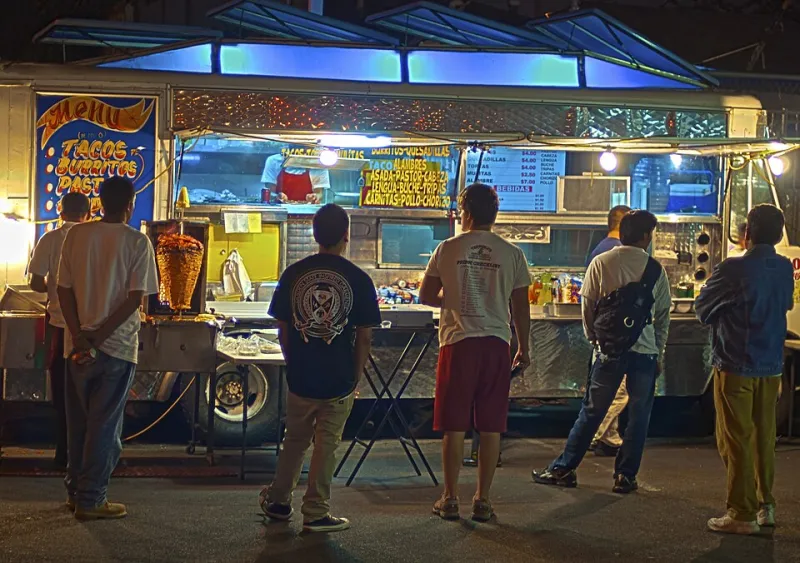
Not the line of curious newcomers who saw the truck on Instagram. Not the group of coworkers doing a "fun lunch" outing. The actual regulars — the construction crew that shows up at 11:45 on the dot, the woman who orders the same thing every Tuesday without looking at the menu, the guy who has a first-name relationship with whoever is working the window.
Regulars are the most ruthless quality-control system in the food industry. They eat at the same place repeatedly because it is consistently good, consistently safe, and consistently worth their time and money. They are not loyal out of sentimentality. They are loyal because the truck has earned it, over and over, meal after meal.
No regulars? That's data. It means either the truck is brand new — possible, give it time — or it has been around long enough to have built a customer base and hasn't. That second scenario is the one worth worrying about.
The taco truck ecosystem in this country is full of people who have sacrificed enormously to do this work right. They deserve your business. The hacks do not. Now you know how to tell the difference.