No Contracts, No Corporate Overlords: How One Family's Salsa Recipe Quietly Took Over the Southwest

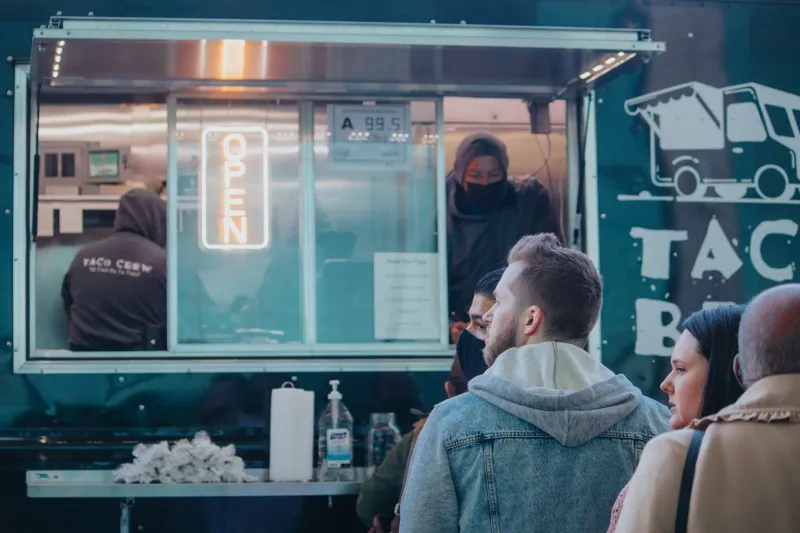
Photo: Mike Baird from Morro Bay, USA, CC BY 2.0, via Wikimedia Commons
Somewhere in a parking lot outside a lumber yard in Albuquerque, a woman named Rosario is doing what she's done every Tuesday morning for eleven years: seasoning a 40-pound batch of al pastor with a spice blend her mother mixed by feel in a kitchen in Jalisco. Forty miles away in Santa Fe, her nephew Edgar is doing the exact same thing. So is her daughter Marisol, parked outside a construction site in Phoenix. And her cousin Beto, who runs two trucks in Denver and once turned down a very serious phone call from a fast-casual investor who used the word "scalable" four times in ninety seconds.
Nobody signed anything. Nobody incorporated a parent company. Nobody hired a consultant to develop a "brand identity." And yet, somehow, this family operates seven trucks across three states, serves a few thousand people a week, and maintains a level of flavor consistency that would make a Michelin-trained chef quietly furious.
This is the taco truck diaspora. And it is absolutely, completely unhinged — in the best possible way.
The Recipe That Launched a Thousand Parking Lot Debates
The origin story, as with most great street food empires, is deceptively simple. Rosario started her first truck in 2013 with $8,000 in savings, a used Chevy step van, and a repertoire of about six dishes she'd been cooking for family gatherings since her twenties. Within eighteen months, the line at her window was wrapping around the block on Fridays. Local food blogs started calling her al pastor "life-changing," which she found both flattering and slightly dramatic.
Then her nephew Edgar, who was between jobs, asked if he could start his own truck using her recipes. She said yes. Then Marisol wanted to move to Phoenix and asked the same question. Also yes. Then Beto. Then Beto's brother-in-law, who lasted eight months before deciding the hours were genuinely inhuman and returning to his previous career in HVAC.
The arrangement has never involved a single piece of legal paperwork. No licensing agreement. No royalty structure. No trademark on the name. Just Rosario's blessing, a two-week apprenticeship in her truck learning the recipes, and an unspoken understanding that if you mess up the salsa verde, you will hear about it at Christmas dinner for the rest of your natural life.
"Lawyers want to make everything complicated," Rosario says, refilling a container of pickled jalapeños without breaking eye contact. "Family is already complicated. You don't need to add paperwork."
The Logistics of Running an Empire on a Group Chat
Here's where it gets genuinely impressive. Maintaining consistency across seven trucks in three states — without a central commissary, without a corporate purchasing department, without a single operations manual — requires a level of informal coordination that would give a supply chain manager an aneurysm.
The family sources their dried chiles from the same two importers they've used since year one, both based in California, both family-run operations with roots in Oaxaca and Puebla. When a supplier runs short — which happens more than you'd think, especially after a rough growing season — the group chat erupts. Someone knows someone. A cousin in Tucson has a hookup. Beto's wife drives a cooler of guajillos across state lines like she's running the underground railroad, except for peppers.
Meat sourcing is handled locally by each operator, but with strict parameters. The cut, the fat ratio, the marinating time — these are non-negotiable. Edgar once tried to shortcut the marinating process on a busy week and Rosario found out within 48 hours through the ancient and terrifying network of family informants known as "someone's mom mentioned it."
The consistency this produces is, frankly, kind of miraculous. A regular customer who follows the family from Albuquerque to Phoenix on a work trip will bite into a taco and feel an almost embarrassing sense of recognition. That's not an accident. That's eleven years of obsessive informal quality control enforced entirely through social pressure and the fear of disappointing a 63-year-old woman who will absolutely bring it up at Thanksgiving.
The Authenticity Tax Nobody Talks About
Expansion, even the informal kind, comes with costs that don't show up on any balance sheet. The further you get from the original truck, the harder it is to maintain the intangible stuff — the accumulated neighborhood knowledge, the regulars who've been coming since day one, the specific energy of a spot that's become genuinely embedded in a community.
Marisol talks about this with a candor that's a little surprising. "In Phoenix, I had to start from zero. Nobody knew me. Nobody trusted me. I was just another taco truck." She spent her first six months essentially auditioning for a city that already had plenty of options. It took a year before she had regulars. Real regulars — the kind who show up in the rain, who text her when she's not in her usual spot, who bring their parents to prove a point about what good food tastes like.
There's also the question of what expansion does to the original. When Rosario's truck got written up in a regional food magazine two years ago, the lines got longer and the neighborhood conversation got complicated. Some of her oldest customers complained — not loudly, but in the way people complain when something they love gets discovered by people who don't fully understand it yet. The truck hadn't changed. The tacos hadn't changed. But the crowd had, and that changes the feeling of a place in ways that are real even if they're hard to articulate.
Rosario shrugs at this with the philosophical detachment of someone who has spent decades feeding people and is done apologizing for being good at it. "If more people want to eat my food, that's not a problem. That's the whole point."
Why the Corporate Model Would Ruin Everything
Every few years, someone approaches one of the family's trucks with a proposition involving investors, expansion capital, and words like "concept" and "rollout." Every time, the answer is some version of no.
This isn't just sentiment. It's strategy, whether they'd frame it that way or not. The thing that makes the food good — the sourcing relationships, the recipe fidelity, the personal accountability that comes from your aunt literally knowing what your salsa is supposed to taste like — is precisely what a corporate structure would systematically dismantle in the name of efficiency.
You cannot franchise obsession. You cannot put family pressure on a line cook who's never met Rosario. You cannot replicate in a training video the specific look she gives you when you've over-salted something.
The taco truck diaspora works because it runs on something franchises can't buy: genuine stakes. Every operator in this family has put their reputation, their savings, and their relationships on the line. There is no corporate safety net. There is no PR team. There is only the food, the window, and the line of people waiting to find out if it's worth it.
Spoiler: it always is.
Beto, for his part, is already fielding questions from his own kids about whether they can open a truck someday. He tells them the same thing Rosario told him: learn the recipes first. Really learn them. Then we'll talk.
No paperwork required.