Same Truck, Different Bank Account: The Hidden Math Separating Taco Millionaires from Taco Survivors
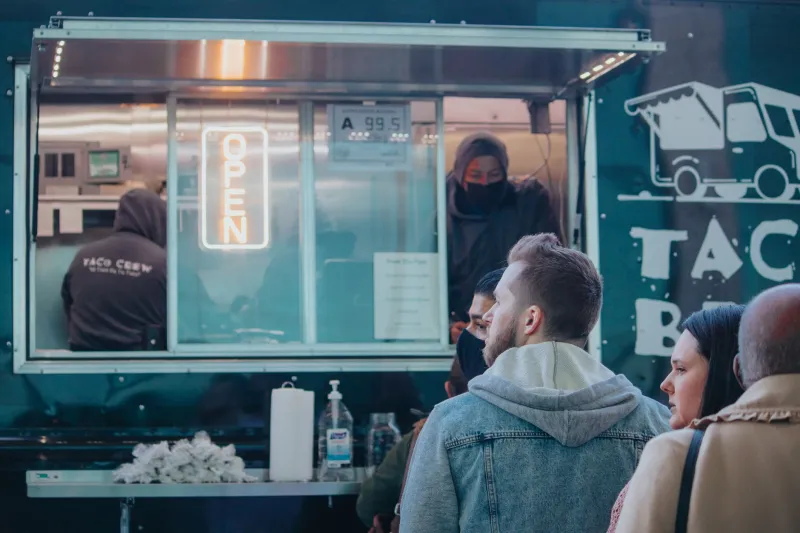
Look, from the sidewalk, they all kind of look the same. Propane tanks. A hand-painted logo that took somebody's cousin three weekends to finish. A laminated menu held on by magnets. A line that stretches past a telephone pole. You'd never guess — standing there with your horchata, trying to decide between the al pastor and the birria — that the truck in front of you might be generating $180,000 a year in profit, while the nearly identical operation two blocks over is quietly hemorrhaging money and running on prayers and family loans.
But that's the reality of the taco truck economy. And it's a lot more brutal, and a lot more fascinating, than most people want to admit.
We spent several months talking to operators across California, Texas, Illinois, and Arizona — some doing extraordinarily well, some barely holding on — to understand what actually separates a thriving street food business from one that's perpetually one bad weekend away from disaster.
Location Is Everything (And Most People Get It Wrong)
Every taco truck operator will tell you location matters. What they won't always tell you is that most of them chose their spot for the wrong reasons.
"I parked near my neighborhood because I knew people there," said one operator in the San Fernando Valley who asked to remain anonymous. "Took me two years to figure out that 'people knowing me' and 'people buying tacos consistently' are two completely different things."
The operators clearing six figures tend to approach location with something closer to cold-blooded business logic. They track foot traffic patterns. They study permit availability in high-density commercial corridors. They position near transit stops, construction sites with rotating crews, or industrial parks where hundreds of workers have exactly 30 minutes to eat lunch and zero desire to drive somewhere.
One operator in Houston — running a single truck that nets her over $150,000 annually — described her location strategy as "almost predatory" with a laugh. "I follow the cranes. Wherever they're building something big, there are workers. Workers eat. Workers eat a lot. And they tip."
The break-even operators, by contrast, often end up in spots that feel right but perform poorly: residential streets with inconsistent foot traffic, areas with too much direct competition, or locations that surge on weekends but go completely dead Monday through Thursday.
Menu Complexity Is a Trap (For Some) and a Goldmine (For Others)
Here's where it gets counterintuitive. You'd think a longer menu means more customers, more options, more revenue. But the data — and the operators themselves — tell a more complicated story.
The highest-grossing trucks we spoke with almost universally ran tight menus. Five to eight items. Maybe a rotating daily special. That's it. The reasoning is pure operational efficiency: fewer ingredients to source, less prep time, faster service at the window, and a dramatically reduced risk of food waste eating into margins.
"My menu has six things on it," said a Chicago-based operator whose truck nets him around $120,000 a year after expenses. "People used to tell me I needed more variety. Now those same people are in line every Tuesday. Six things, done perfect, beats twenty things done okay every single time."
The struggling operators, more often than not, are running menus that ballooned over time — each new item added to please a customer, accommodate a request, or chase a trend. The result is a prep nightmare, inconsistent execution, and food costs that are nearly impossible to control.
There is, however, an exception. A small number of high-volume operators run deliberately complex menus as a differentiation strategy — but they back it with serious kitchen infrastructure, multiple staff members, and systems that would make a chain restaurant manager nod in reluctant respect. For them, complexity is a moat. For everyone else, it's quicksand.
The Staffing Equation Nobody Talks About
Labor is where a lot of taco truck dreams go to die quietly.
The math sounds simple: hire help, sell more tacos, make more money. But the operators who've cracked the profitability code are almost obsessively precise about how they structure their teams — and when they bring people in versus when they go it alone.
Several high-earners described running solo or with a single family member during slower shifts, then scaling up to two or three people only during proven peak windows. They've essentially turned staffing into a variable cost that flexes with actual demand rather than a fixed expense that eats margin regardless of sales volume.
"I paid two people to stand around for a year before I figured out my real busy hours," admitted one operator in Phoenix. "Now I work the slow shifts by myself. I'm tired, yeah. But I'm not broke."
The break-even crowd tends to either overstaff out of optimism or understaff out of cost-cutting — both of which tank the customer experience and, by extension, the repeat business that makes or breaks a truck's long-term economics.
Pricing Psychology: The $1 Difference That Changes Everything
Nobody wants to be the expensive taco truck. But the most profitable operators have quietly made peace with charging slightly more than the competition — and they've learned how to do it without losing their regulars.
The key, several operators explained, is perceived value rather than raw price. A taco at $4.50 with house-made salsa, fresh cilantro, and a protein that's been marinating since 4 a.m. feels like a deal. The same taco at $3.75 with jarred salsa and a rushed cook feels like a ripoff. Customers aren't just buying food. They're buying confidence that someone gave a damn.
One operator in East LA described raising her prices by $1 per item two years ago and losing almost nobody. "People didn't leave. They just said 'okay' and handed me the money. I was scared for nothing. The ones who left over a dollar — they weren't my customers anyway."
The operators stuck at break-even often haven't raised prices in years, absorbing every ingredient cost increase directly into their own margins, essentially subsidizing their customers' lunch out of their own pocket.
The Invisible Variable: Repeat Business
Every operator we spoke with, regardless of their income level, agreed on one thing: the regulars are the business. Not the viral moment. Not the food blogger visit. Not the lucky Friday when a concert lets out nearby. The person who shows up every Tuesday and orders the same thing — that's your mortgage payment.
The profitable trucks have systems, even informal ones, for recognizing and rewarding that loyalty. They remember names. They remember orders. They give the occasional bonus taco without being asked. They treat the window like a relationship, not a transaction.
The struggling trucks treat every customer like a stranger. Which means every customer eventually acts like one.
So What's the Real Difference?
It's not the food. It's almost never just the food. The operators making real money aren't necessarily cooking better than the ones barely surviving — though execution matters. What separates them is a combination of strategic location selection, disciplined menu curation, flexible labor management, confident pricing, and a genuine obsession with repeat customers over one-time visitors.
The taco truck economy rewards operators who think like business owners while cooking like they have something to prove. Which, honestly, is the most Mexican street food thing imaginable.
The trucks that struggle tend to lead with heart and follow with guesswork. The trucks that thrive lead with heart and follow with a spreadsheet.
Both kinds of trucks are out there right now, parked somewhere near you, looking almost identical from the sidewalk. The difference is entirely invisible — until you look at the bank statements.