The Glow-Up Problem: What Happens When Your Taco Truck Gets Famous
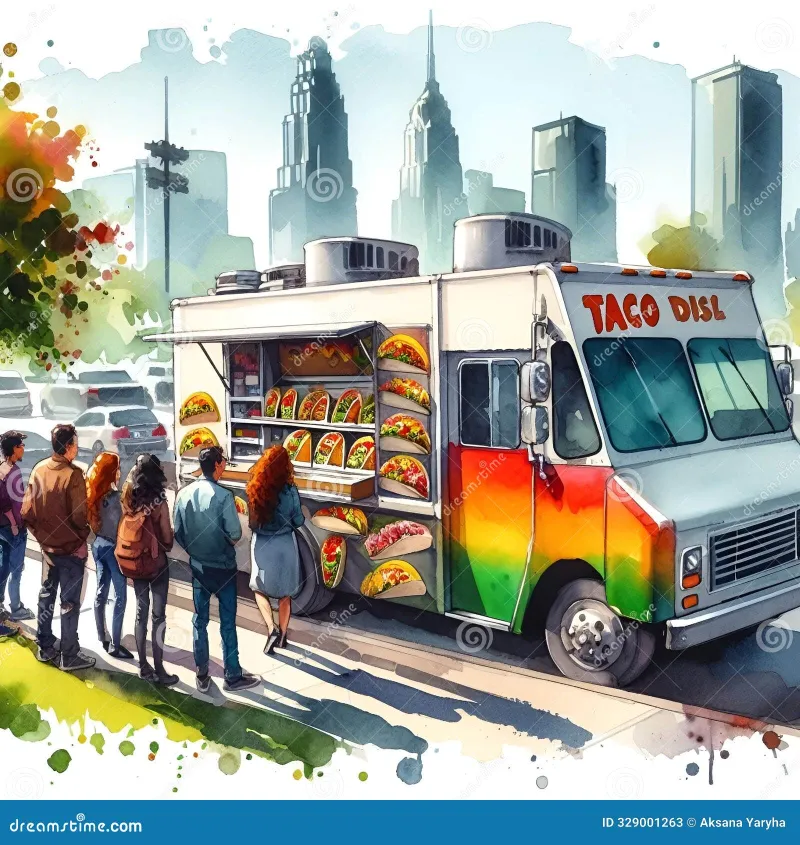
Photo: taco truck busy street line of customers urban neighborhood, via thumbs.dreamstime.com
There's a specific moment that taco truck veterans can describe with almost cinematic precision. It's the morning you pull up to your usual spot and notice the line is longer than it's ever been—but the faces in it are different. New neighborhood. New shoes. Someone near the front is holding a ring light.
Congratulations. You've been discovered. Whether that's good news depends entirely on who you ask, and how long they've been eating there.
The story of taco truck gentrification is not a simple villain-and-victim narrative, no matter how much the internet wants it to be. It's a collision of legitimate, competing interests: immigrant entrepreneurs who deserve financial success, longtime customers who feel their community spaces slipping away, food media that genuinely loves what it covers while simultaneously changing it, and a broader American food economy that has a long, complicated history of profiting from cultures it doesn't fully respect.
So let's talk about it without pretending it's easy.
The Discovery Cycle (And Why It's Exhausting)
The playbook is numbingly familiar at this point. A truck has been operating quietly for years, feeding a specific neighborhood with food that is excellent because it has to be—there's no marketing budget, no PR firm, no second chances. The food speaks for itself or the truck closes.
Then someone writes a Yelp review. Or a food blogger swings by. Or, increasingly, a TikTok video gets traction—a thirty-second clip of a birria taco being dipped into consommé, shot in that slightly oversaturated vertical format, and suddenly the truck that used to have a ten-minute wait has a forty-five-minute one.
The first wave of new customers is usually fine. Curious, respectful, willing to learn. The second wave, the one that arrives after the second article or the Instagram feature, is where things start to get complicated. These are the customers who arrive with expectations shaped by content rather than context. They want the experience they saw online, and they're occasionally surprised that the truck doesn't have air conditioning or a dedicated parking structure.
For truck owners, this attention is a double-edged machete. More customers means more revenue, which means stability, which means being able to pay workers better and maybe sleep more than five hours a night. But it also means pressure—to scale, to standardize, to smooth out the rough edges that are often inseparable from the authenticity people claim to be coming for.
The Price Question Nobody Wants to Answer Honestly
Let's address the taco in the room: prices go up when trucks get famous. Sometimes modestly, sometimes dramatically. And the reaction to those price increases reveals a lot about who is doing the reacting.
Longtime customers from the neighborhood—often working-class, often Latino—feel the sting of a price hike in a direct, practical way. When a truck that charged $1.75 for a taco moves to $3.50, that's not an abstraction. That's a different calculation at the end of a workday. The truck that used to be a reliable, affordable option in their food landscape has shifted into something slightly different.
New customers, who often drove from another part of town specifically because of the press coverage, frequently don't notice the price increase at all—or they see it as confirmation of quality. "If it's this good, it should cost more" is a sentiment that sounds reasonable in isolation and is genuinely harmful in context.
Truck owners are caught in the middle, making decisions under financial pressure that the food media covering them rarely acknowledges. Operating costs have risen dramatically. Commissary kitchen fees, fuel, ingredient costs, permit fees—the economics of running a food truck in 2024 are brutal, and charging $1.75 for anything is often not financially survivable regardless of what the neighborhood's appetite for change happens to be.
The Trucks That Scaled Without Selling Their Soul
Here's where the story gets more interesting than the hot take version usually allows: some trucks have navigated this tension genuinely well, and their strategies are worth studying.
The ones that seem to manage it best share a few traits. They're transparent about what's changing and why. They maintain at least some prices that keep the original customer base in the fold, even if the menu has expanded. They hire from the community they came from. And critically, the food itself doesn't change in the ways that matter—the tortillas are still made the same way, the salsa still has the same heat level, the portions still reflect a culture that believes feeding people properly is a form of respect.
What they resist is the aesthetic overhaul that signals a change in intended audience more than anything else. The moment a truck repaints itself in millennial pink and starts offering "elevated street food," it has made a choice about who it's cooking for—and it's usually not the people who were there first.
Venture capital, when it enters the picture, almost always accelerates this drift. There's nothing inherently wrong with investment, but VC money comes with growth expectations that are structurally incompatible with the kind of small, neighborhood-rooted operation that made the truck worth investing in to begin with. You cannot simultaneously chase a 10x return and maintain the particular magic of a truck that's been feeding the same block for fifteen years. The math doesn't work.
What the Regulars Actually Think
Ask the longtime customers of any recently-discovered taco truck how they feel, and you'll get answers more nuanced than the discourse usually captures. Pride, frequently—my spot is finally getting the recognition it deserved. Frustration, almost always—but now I can't get a spot in the lot on Fridays. And something harder to name, a low-grade grief for the version of the place that existed before it became a destination.
"It's still the same food," one longtime customer told us outside a truck in East LA that had recently been featured in a national food publication. "But it doesn't feel the same. I don't know how to explain that."
He doesn't need to explain it. Anyone who has watched a neighborhood change around something they loved understands exactly what he means.
The Uncomfortable Conclusion
Taco truck gentrification doesn't have a clean resolution, because it's not a story with clear heroes and villains—it's a story about what happens when a food culture built by and for a specific community gets absorbed into a broader American appetite that is genuinely enthusiastic but not always accountable.
The trucks that survive this absorption with their identity intact are the ones run by owners who decided, early and firmly, that their food was never going to be a performance for someone else's benefit. It was always just dinner. Good dinner, made with real technique and real ingredients and real love, for real people.
The ring light crowd is welcome. But they eat on the same terms as everyone else.
No apologies.